How get a “complete neighborhood” by market forces, not planning? Start with smaller buildings

Coase-graph1From Market Urbanism writer Emily Washington: “Earlier this week I attended an Urban Land Institute event about DC’s new development, The Yards.  This is a 42-acre area that was formerly a manufacturing center for the Navy.  In 2003, Forest City Washington purchased the site from the General Services Administration for residential, retail, and office redevelopment.

“During the presentation, I was reminded of Ronald Coase’s 1937 paper, ‘The Nature of the Firm’.  He explains that firms exist, rather than each worker serving as his own contractor, because firms reduce the transaction costs of contracting for individual projects:

“‘In economic theory we find that the allocation of factors of production between different uses is determined by the price mechanism.  The price of factor A becomes higher in X than in Y.  As a result, A moves from Y to X.  Yet in the real world, we find that there are many areas where this does not apply.  If a workman moves from department Y to department X, he does not go because of a change in relative prices, but because he is ordered to do so.’

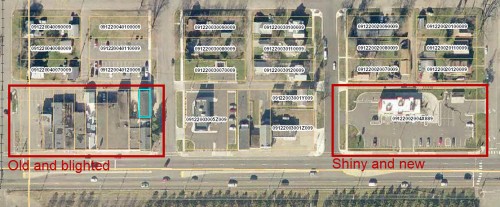
“In the case of The Yard, this means that Forest City Washington is saving money on development expenses…and giving up the price system which would better direct firms developing individual parcels to know what their customer want.  This tradeoff is represented above.  Firms will increase in size until the cost of not being able to rely on the price system is equal to the transaction costs of contracting work out.

“During her presentation, Deborah Ratner Salzberg stressed her firm’s objective of creating a ‘complete neighborhood’ with a balance of residential development and a mix of retail.  By one firm developing this entire small neighborhood, they had the advantages of knowing which tenants were likely to sign leases in which buildings and controlling the vision for development within one company.  However, they were not bidding against other developers to determine the highest-value buildings for each parcel, meaning that planning, rather than the price mechanism, shaped the definition of a ‘complete neighborhood.’”  Full article here.

In Bangalore, “low-rise consumes land, high-rise consumes energy”…so mid-rise mixed-use!

largestFrom Atlantic Cities writer Mark Bergen: “BANGALORE, India — Ascend to the top floor of the UB Tower downtown, and you can nearly see the city’s full expanse from all sides.  The skyscraper, the centerpiece of the five-year-old luxury shopping mall UB City, is one of the city’s tallest structures.  It stands 420 feet.

“More than 100 buildings rise higher in both New York and Hong Kong, though each is less populous.  Cities in China and southeast Asia rise high, but Indian ones did not.  Most grew like Bangalore: outwards and compact.  It leads to a natural question: Why aren’t Indian cities that tall?  But there are others who pose a very different query: Why should they be?

S. Vishwanath, an urban planner, lives in Vidyaranyapura, a neighborhood in the city’s far northwest with rows of squat, single-family homes and buzzing shops.  He would like every neighborhood to resemble his.  India, he claims, is best suited for ‘poly-nodal’ urbanism — a bunch of self-contained cities within the city.  ’People won’t have to travel outside of two or three kilometers,’ he explains.

“That vision is a relief for anyone who has braved Bangalore rush hour. But he is less concerned with traffic than resources, particularly water.  Tall buildings, where water has to move up several stories, can have wider ecological footprints.  ’While the low-rise consumes more land, the high-rise consumes more energy,’ says Sathya Prakash Varanashi, an architect who has worked in the city for two decades.

“Both men do, however, wield judgment on the impact vertical growth has on society.  They see shorter, dense structures as more conducive to public life.  ’The strength of India has always been that there is mixed land use in every part of town,’ argues Vishwanath.  Residents dwell alongside shop owners, street vendors and the legions of working poor.”  Full article here.

Singapore shophouse was bookstore, stripped down to its structure, becomes residence

Lucky-Shophouse-by-CHANG-Architects-3From Decoist writer Sherry Nottingham: “A couple in Singapore decided that they would try and bring back their childhood days by converting an old book shop in the historic Joo Chiat Place in Singapore.  With the help of CHANG Architects a careful restoration and renovation project was embarked on.

“The building purchased by the couple was a book store called ‘Lucky Book Store’ and was originally built way back in 1920.  The idea of the owners was to convert the main structure of the book shop into a spacious dwelling area, while a single-story modern home would be constructed on an empty plot right behind the shop, and linking both these areas and surrounding the newly added home with a beautiful garden.

“The interiors of the book shop were made less congested by removing all the existing non-structural parts.  This created large and flowing spaces, while it also showcased the historic past of the edifice.  ”  Full post with several images here.

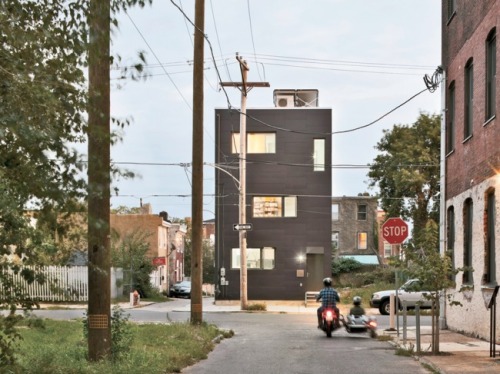
Trend? Miami gets another small, attached, multi-story, mixed-used building with no parking

Hermes_DesignFrom a press release from Keenan/Riley: “K/R’s recently completed Garden Building is a two-story mixed-use building with an intensively landscaped green roof in the heart of the Miami Design District.  The original site served as an expansive garden for private and public events.  The new Garden Building expands on this vision, incorporating retail space on the ground floor, a mixed-use second story space and a green roof garden.”  On the building’s facade, “just above street level, a series of jewel-like glass ‘vines’ are suspended within finely crafted frames.”  Full press release here.

For designing small, attached urban buildings, what  wisdom can Terry Riley share?  From an email from Mr. Riley:  ”Starting out as a young architect in New York City, I became very used to the idea that the facade defines the structure — in many more ways than in suburbia where buildings tend to be free-standing.”  You heard it here first, folks: focus on the facade.  Congrats on an attractive, exemplary building!

Indianapolis old, small, mixed-use “encouraged ordinary citizens to become developers”

Indianapolis-Downtown-2009-09-15-024From Urban Indy writer Graeme Sharpe: “Have you ever been to an old downtown and marveled at the historic buildings? Have you ever wondered how they could create such beautiful buildings on such small budgets, compared to the placeless architecture we are told is barely affordable today?”

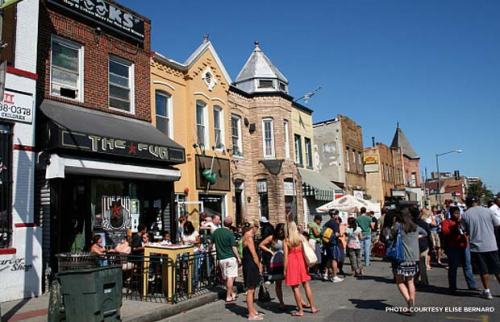
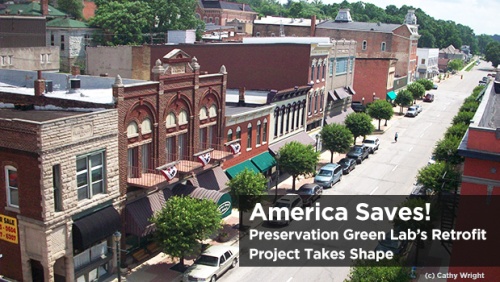
“The truth is that those multi-story, mixed-use buildings lining the street were built by a different culture.  But that old American culture was a very clever one, and we can profit from studying what they did right, and how they did it.

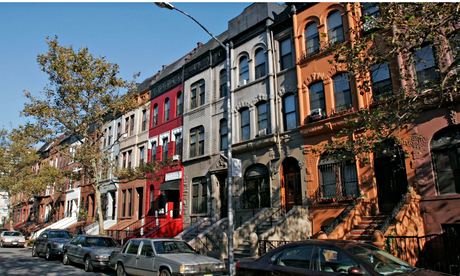
“The typical traditional urban building is between 20 to 40 feet wide, and between 60 to 200 feet deep.  This small width was a product of structural engineering limitations.  A traditional building with masonry walls and wooden floors could not span further without significant cost increases

“Perhaps even more importantly, the small sizes encouraged ordinary citizens to become developers.  Many buildings were financed directly by business owners or residents, who would offset building costs with lease income from unused spaces.  These self-developing streetscapes ensured that no single developer or architect controlled the evolution of the city.  It would reflect a social, shared history instead.

“Traditional buildings, and traditional streetscapes by extension, never happened overnight. They evolved over time, as each small plot was filled in and then raised upwards.  The neat thing about masonry walls is that they can support an incredible amount of weight if they are braced at each floor level, so adding a new floor on top was usually a simple process.

“Minimum Parking Requirements, whether for permitting compliance or loan approval, have been the single greatest enemy of the traditional building technique.  The key lessons here are to create a development environment where buildings can start small, expand gradually, and create mutually beneficial relationships with their neighbors.”  Full post here.

Townhouses with garages in front don’t have to be ugly and anti-urban, says Old Urbanist

SFtownhousesFrom Old Urbanist blogger Charlie Gardner: “Do front-loading garages truly present an insoluble design problem for the rowhouse format?  A quote from Andres Duany and Elizabeth Plater-Zyberk’s The Second Coming of the American Small Town illustrates this common point of view: ‘When housing achieves a certain density but parking remains a necessity, the car’s house (the garage) overwhelms the human’s house. No architect is skillful enough to make human life project itself on the façade of a house when 60 percent of it is given over to garage doors.’

“Taking the 60 percent figure as a rule of thumb, we’ll then say that no more than 50 percent of a façade can be occupied by a garage door before the aestheticsbecome intolerable.  Using this figure, we get, for single-car garage rowhouses, a width of no less than 16′ [and] for two-car garage homes, a width of no less than 32′.

“Now, 16 feet is an extremely common width for rowhouses in the older neighborhoods of Philadelphia, Baltimore and Washington, D.C., but contemporaryattempts to integrate standard 8′ garages on these lots usually have not, in my opinion, succeeded.  What if we were to widen the lot a bit more?  These early 20th century rowhomes in the Sunset neighborhood in San Francisco, at 25 feet across, lessen the visual impact of the garage doors.

MCtownhouses“Once we take a look at models beyond the United States, however, we see that far better street level results can be achieved using the same dimensions.  These Mexico City homes, at around 25 feet wide, present a friendlier face to the street.  The garage door itself, stylistically integrated with the window bars and iron balcony railing, is relatively inconspicuous.”  Full post here.

ULI Small-Scale Development Meet-Up in New Orleans, Feb 28 to March 1. Register now!

ULI recently started a Small-Scale Development initiative, including a series of 2-day meet-ups around the country, special events at larger ULI conferences, and an online community. From the website: “Join other entrepreneurial developers who are focused on infill and smaller-scale projects for this exclusive ULI members only program.  The result is an intimate alliance of professionals engaged in an ongoing exchange of best practices in the niche area of small-scale and infill development.”

I went to the 2nd meet-up (last year in DC) and enjoyed it, and more importantly the program is going in the right direction, strengthening small-increment infill developers individually and as a community.  The next meet-up will be Feb 28 to March 1 in New Orleans. I’ll be attending, and I encourage you to consider and fwd this invitation to anyone who may be interested.  Below is the program outline, and you have to apply at the link above.

  • Thurs, Feb 28, 3 PM: Registration followed by panel discussion, reception, and dinner.
  • Fri, March 1, 8:30 AM to 5 PM: Panel, project tour, skills instruction, and deal sharing.
  • Panel Discussion: Lessons from the Worst Deal I Ever Did
  • Panel Discussion: New Normal, New Opportunities
  • Project Tour & Case Study: Adaptive Use, Infill
  • Skill Instruction: Entity Formation for Small Developers
  • Skill Instruction: Capital Structure Options and Implications
  • Skill Instruction: Finding the Best Consultants
  • Skill Instruction: Deal Presentation Tips
  • Attendee Deal Sharing: What Can I Do Differently

Building urban neighborhoods around the globe by promoting their fundamental building block: small, attached, prototypical, adaptable buildings. Also join our group on LinkedIn or add images to our group on Flickr.

Twitter Updates

Enter your email address

Join 805 other followers

Blog Stats

  • 59,684 unique views all-time

Follow

Get every new post delivered to your Inbox.

Join 805 other followers